icon-close
close

27 Oct 2026

SCGC and ATCM Explore Advanced Recycling of Used XLPE Insulation for Electrical Wires in Thailand

dot 4
Banner En
Business Circular Economy Innovation Solutions Sustainability
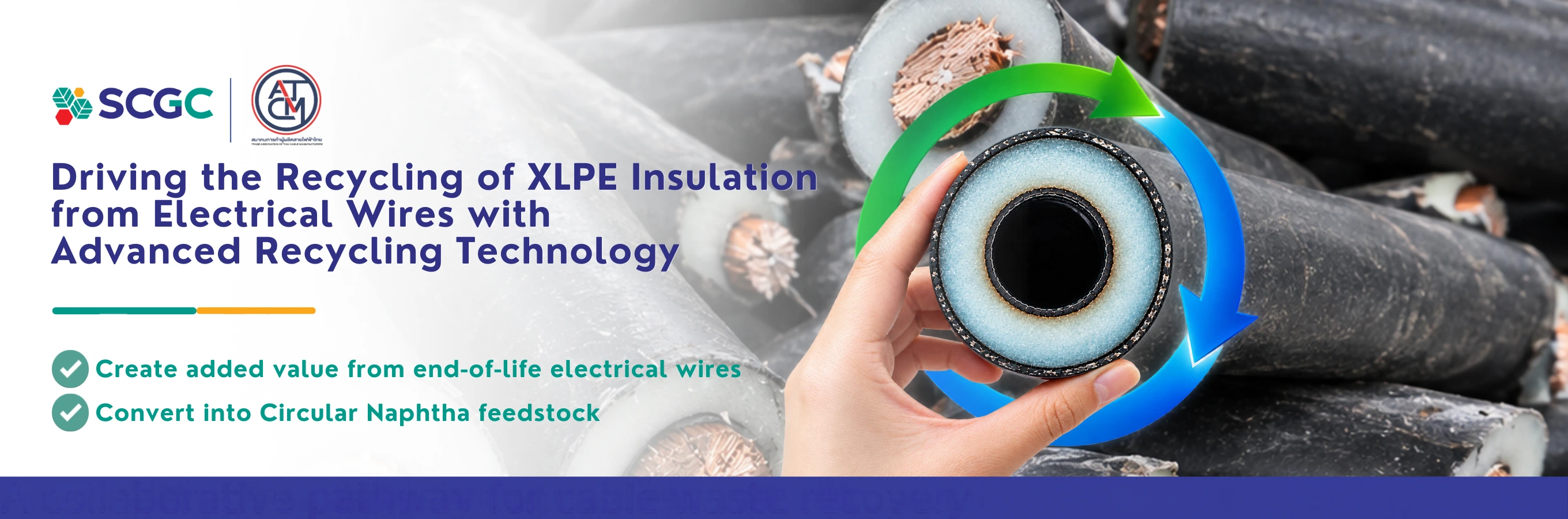
Due to the crosslinked structure of Cross-linked Polyethylene (XLPE), which forms a three-dimensional network through covalent crosslinks, the material offers excellent strength and dimensional stability under elevated temperatures and electrical stress. This makes XLPE widely used as an insulation material for electrical wires. However, its permanent crosslinked structure also presents a significant recycling challenge, as XLPE cannot be melted and reprocessed like conventional polyethylene. As a result, more than 2,000 tonnes of degraded or end-of-life XLPE wires are sent to landfill each year, with no opportunity for recovery or recycling.

To address this recycling challenge, SCGC, a leading integrated polymer and sustainability solutions provider, and the Trade Association of Thai Cable Manufacturers (ATCM) have joined forces to explore the use of advanced recycling technology to process used XLPE insulation from electrical wires. The objective is to convert the waste into hydrocarbon streams, including circular naphtha, which can be used as feedstock for petrochemical production and the manufacture of high-quality recycled plastics under the SCGC GREEN POLYMER™ brand. These materials can offer virgin-equivalent performance and are supported by ISCC PLUS certification across the supply chain.

This collaboration builds on SCGC’s expertise in Green Polymer innovation and advanced recycling technology, which enables difficult-to-recycle plastic waste—including mixed plastics, multi-layer packaging and XLPE insulation from electrical wires—to be recovered and brought back into productive use, supporting the principles of the circular economy.

As part of the development, SCGC evaluated a range of used electrical wire types to assess the process’s ability to handle XLPE with different crosslinked structures and convert the material into recoverable hydrocarbon streams, including:

    • Both principal crosslinking chemistries: peroxide-crosslinked and silane-crosslinked insulation
    • A range of wire voltage levels: including low-, medium- and high-voltage wires
    • Complete multilayer wire structures: allowing both insulation and outer jacket layers to be processed together without prior separation
    • Mixed wire waste streams: reflecting the types of wire scrap that may be encountered in real-world applications

Under the conditions tested, the recycling process demonstrated the ability to convert the material into circular naphtha without generating solid residue requiring further disposal. The initial results indicate the potential to manage XLPE waste from both wire manufacturing scrap and end-of-life wires removed from service.

For manufacturers currently incurring costs to manage and dispose of crosslinked scrap, this technology could offer an opportunity to view these materials differently—from waste that requires disposal to a recoverable material stream that can be put back to productive use and potentially create value. For more information about XLPE recycling, please contact: wire&cable@scg.com
arrow-02-r
arrow-02-l